

Industry Trends & Market Intelligence
Corporate learning has entered a new operating reality.
The question is no longer whether training should be online or offline. The dominant model today is hybrid—and this shift is fundamentally changing how organizations must think about physical training spaces.
Hybrid Is No Longer a Temporary Solution
What began as a workaround during disruption has now matured into a standard delivery model. Organizations today routinely conduct:
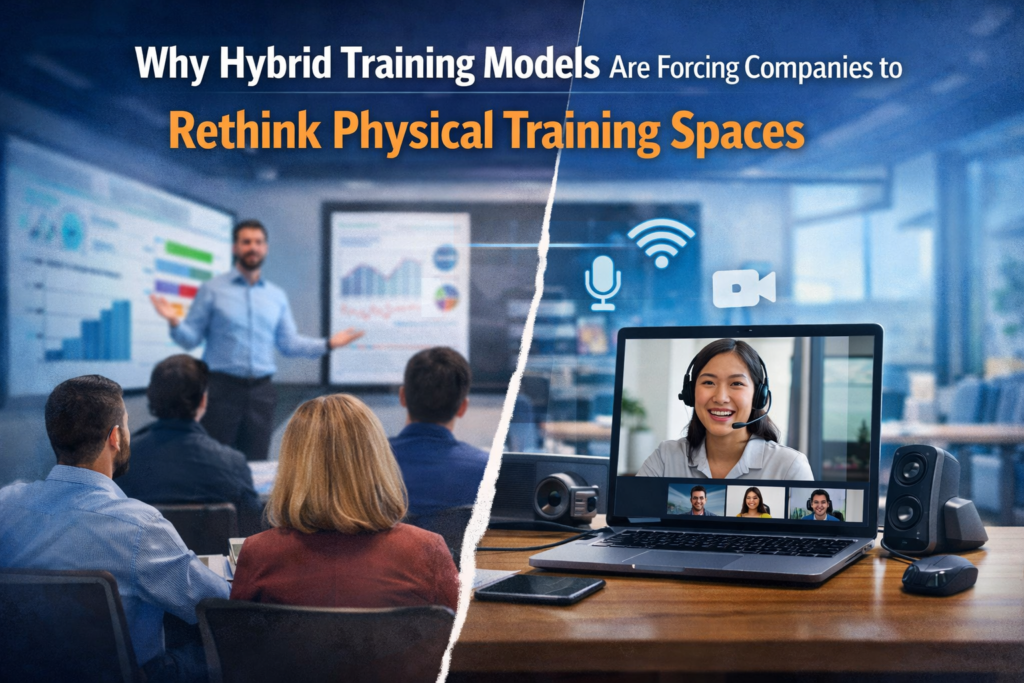
- In-person sessions with remote facilitators
- Physical classrooms with virtual participants dialed in
- Programs that must be recorded, streamed, and repurposed
This evolution has elevated physical training rooms from being simple venues to becoming critical delivery infrastructure.
The Infrastructure Gap No One Talks About
Despite this shift, most training spaces are still designed for:
- Traditional meetings
- One-way presentations
- Static seating layouts
They are not designed for hybrid learning.
The result?
- Poor audio capture for remote participants
- Visual limitations for hybrid facilitation
- Technical interruptions that disrupt flow and engagement
When infrastructure is misaligned, even the best training content underperforms.
What Organizations Are Optimizing for Now
Progressive L&D teams and trainers are now prioritizing:
- Plug-and-play AV readiness (not ad-hoc setups)
- Stable, enterprise-grade internet connectivity
- Room layouts that support interaction and learning dynamics
- Operational reliability over superficial aesthetics
This is why dedicated training environments are increasingly replacing hotels and improvised office rooms.
The Strategic Reality
Hybrid training does not reduce the importance of physical spaces.
It raises the bar.
Organizations that continue to treat training infrastructure as an afterthought will struggle to extract ROI from even their most well-designed programs.
